
Piano Teaching
Discover a world of great music...
With so many piano composers and styles to choose from, students are encouraged to explore the repertoire as widely but always to select music that interests them. This approach helps sustain each student's musical interest but inspires the development of new skills and techniques along the way leading to great musical accomplishment.
Working with such a wide range of students at different ages and levels is both rewarding and invaluable: to appreciate how students learn and develop across a much wider plane and the challenges faced at advanced levels provides perspective and understanding, and help shape the learning programmes of those just starting out.
Establishing the basics
Taking your first steps as a beginner may be daunting but with a carefully-selected programme of attractive and enticing pieces, and supportive exercises to develop your technique, you will soon have the basis of a musical foundation on which to build.
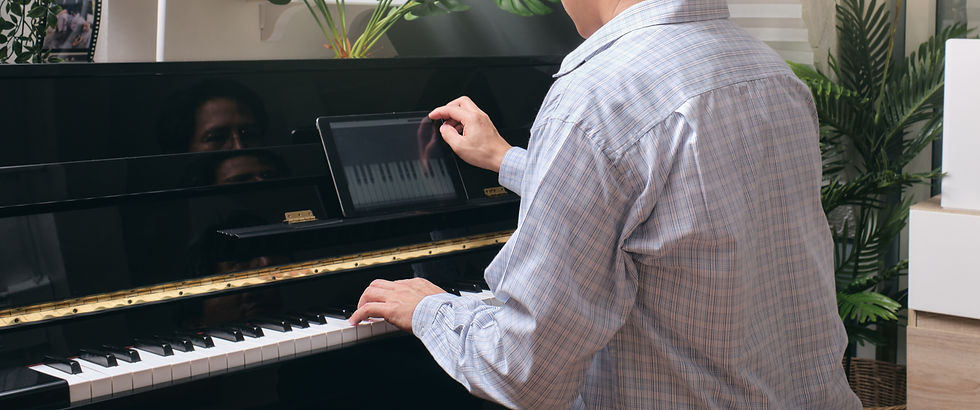
We will start by learning how to sit at the piano and the importance of adopting a good hand position. After a few simple warm-up exercises to get some mobility in the fingers, we will learn our first piece together. This will be shown to you without the music, initially, to help you develop a better aural sense of the music and to make your first piece more accessible.
You will, of course, still be taught how to read music: a vital skill that gives pupils the confidence to discover new music independently; however, approaching a new piece without the music helps new students actually play something meaningful at their first lesson without being overwhelmed with reading and playing simultaneously.
To develop rhythmic awareness and listening skills further, a number of duets intended for beginners will be introduced. But, please don't worry about this: many beginners find the playing of duets really enjoyable and are surprised by just how good the ensemble sounds! Having worked with many beginners, rest assured, we will find the one that is right for you.

Piano Accompaniment
Completing the ensemble...

Est. 2000
IMJMusic
piano | theory | accompaniment

Welcome Guide
2024-2025
May I take this opportunity to welcome you to IMJMusic and to say how much I look forward to working with you.
Whether you're a novice about to take the plunge for the first time or somebody rediscovering the piano later in life, learning the piano can be an immensely rewarding and stimulating activity, and I'm so pleased that you are contemplating learning with me. With such a wide range of styles to choose from, the journey ahead is sure to be an exciting one, full of rich musical discoveries.
To help you get the most from your lessons I have prepared this short Welcome Guide, which should provide you with all the information you need to get started. If you have any questions please do not hesitate to get in touch.
Contents



The introductory session
The introductory session is an informal and friendly occasion, allowing prospective students (and their parents, in the case of a child) to meet me and to visit the piano studio before deciding whether I am the right teacher for them. Most students are a little apprehensive meeting a new teacher for the first time but please try to relax. Learning the piano should be an exciting an enjoyable activity and I am here to ensure that happens. Having worked with hundreds of students from beginners to advanced level, I'm confident that we can find the right learning programme for you.
Understanding you
When we first meet in the studio, I'll start by asking a few simple questions about what prompted your interest in the piano and what it is you would like to achieve with your playing. You may already have a clear idea as to the pieces you'd like to play, or a specific grade you’d like to achieve. Alternatively, you might not have any predetermined plans at all and prefer to see where the journey takes you.
However, it is probably worth giving it some thought as to what it is you want from your lessons - that way, I can ensure we’re working towards a common goal. After all, you’ll be spending many hours at the piano developing your skills, so it’s important that what you do is as rewarding and enjoyable as possible. Once we’ve discussed your musical interests and aspirations, it will be time to see what you can do at the piano.
What to expect
If you’re a complete beginner, we will take things slowly and methodically, starting with the basics and going from there - such as learning how to sit at the piano and how to hold the wrists, hands and fingers correctly. Next, we will move on to some simple exercises to get the fingers moving before we embark on the learning of your very first piece: an attractive jazzy piece that is sure to sound great on the studio’s grand piano.
If you come to IMJMusic as a student who has already played before, the introductory session will be a little different. Instead, I’ll be looking forward to hearing you perform a few pieces to me - maybe you could choose two or more contrasting pieces that you enjoy playing and best demonstrate your ability. Try not to choose anything too tricky as you may find it difficult to relax and this won’t give a true reflection of your skills. You can always play something more impressive later if you feel up to it.
How you can help me to help you
To help provide a better understanding of how I can deliver lessons which are right for your personality and future aspirations, it is useful if to know more about you. To do this, why not complete the Preparatory Form before we meet? This gives you an ideal opportunity to tell me more about your previous experience, pieces you would like to learn, and how much time you have to practise, as well as providing a broader picture of your availability and more.
What happens afterwards?
It is hoped that you will enjoy your introductory lesson here at IMJMusic, and that you will be confident in the facilities and expertise I can bring to your musical journey. If you feel ready to continue, this is great news; however, if you would like to go away and think about what you would like to do next, of course, that is fine, too. Should you have any questions whatsoever, please do not hesitate to contact me.

Frequently Asked Questions
If you’re new to lessons and learning a musical instrument for the first time, it’s inevitable you might have a few questions about the piano. Here are the things most pupils want to know about...
Will I need a piano straightaway?
Few students commit to buying a piano without taking a few lessons first, which is perfectly understandable. However, you will need to think about buying a piano soon otherwise you won’t be able practise between lessons, which is essential for musical progress.
How much should I spend on my first piano?
A good quality instrument that sounds pleasing to the ear and responds well to the touch will always be more inspiring to play, so my advice here is to spend as much as you can reasonably afford. With a budget of around £750 to spend, a new digital piano, complete with integrated cabinet and pedals, such as the Yamaha YDP-145, is a good start for most beginners.
For more experienced players, a traditional acoustic piano, such as the Yamaha U1 is recommended, and is likely to cost around £5,000 for a pre-owned instrument from a piano specialist. Although such pianos may be purchased from private sellers for considerably less, my advice is to tread carefully as such pianos may need expensive repairs. You will also need to factor in the cost of moving the piano, too.
Renting a piano from a reputable company is another option to consider. This would enable you to take lessons on a quality new (or nearly new) piano for a period of time before deciding what to do next. Some retailers offer hire-purchase schemes, should you decide to keep the piano.
Is there any help to buy?
Yes. The Arts Council England offers a scheme, which aims to make it much easier for parents to provide quality musical instruments for their children through the provision of interest-free loans. The scheme is also open to young people aged 18-25. For further details visit: www.takeitaway.org.uk
How much practice should I do?
Beginners should practise for at least 30 minutes a day, rising to an hour at the advanced level. This will ensure that swift progress is made, and that the student gets the most from each lesson. To help you make the most of your lessons, study my top tips on the next page.
How long will it take me to reach Grade 1?
Most students usually reach this first milestone within about nine months, sometimes sooner, provided they practise regularly. Younger pupils may need longer, but this isn’t always the case. Enthusiasm and persistence go a long way here!
Do I have to study music theory?
Encouraging students to learn about music theory not only accelerates the learning of new music but enables them to make sense of the music they see, hear, and play, resulting in more insightful and expressive playing. Such skills and knowledge become invaluable in music exams. Learning about music theory should only require a small investment of your time, so don't worry that lessons won't have a practical emphasis because they will. A little knowledge certainly goes a long way!
Do I have to take music exams or play at workshops/concerts?
These decisions are left entirely up to you. Most students find working towards a music exam can really help motivate their practice, however, it’s your choice as to whether you feel it is right for you. Similarly, performing at student concerts can help develop your confidence and improve your playing but this is optional.
What can I do to really help my child succeed?
Almost all children will need to be encouraged to practise, particularly in the early stages, so it is important to take time to listen to your child play. You may need to monitor their practice, particularly if they play on a digital piano with headphones to ensure that they are practising what they should be doing! Rest assured, I will do my utmost to find music that inspires your child to play, however, your supportive role here is invaluable in the teaching process. Such encouragement helps your child’s musical development and reminds them that what they do is compelling and has real value.
ue.

Top tips for success
Many non-musicians believe that it is only the talented that can play a musical instrument. Whilst it certainly takes an exceptional musician to be a concert pianist, everybody has the potential to enjoy learning a musical instrument if they really want to. The trick is knowing how to develop your musical skills and technique effectively. Here’s what you should be doing...
Establish a good routine from the outset
Set aside a regular time for your practice every day. Choose a time when you are most awake and least likely to be disturbed. A good practice routine from the outset will help develop “muscle memory” in the fingers leading to more effective and fluent music learning.
Practise sufficiently
Learning to play the piano will take time and effort so it is important that you practise as much as you can. Thirty minutes’ a day for a beginner is ideal, rising to about an hour at advanced level. To make the most of every lesson it is essential that you practise regularly during the week. Using the lesson merely as an opportunity to practise isn’t the right approach and will affect your progress considerably.
Develop the art of effective practising
“Practice makes perfect” is what we’re told but remember practice is only effective if pieces are practised correctly. Simply playing from beginning to end, without being attentive to the detail is unlikely to solve musical problems. So, take the time necessary to focus on trickier bars by practising them slowly, repeatedly, and attentively. Practising with separate hands might also be necessary. Whatever the level, methodical practice is essential for secure and confident playing.
Keep the fingers in shape
Whilst practising scales and arpeggios is rarely considered a fun activity, it is a really effective way to develop speed and agility across all the fingers, which, in time, will help you shape musical lines more expressively. It is also a great way to develop key awareness as you explore the unique shape of each musical scale through the process. The short technical exercises in Edna-Mae Burnham’s excellent A Dozen a Day series is also highly recommended. These are easy to pick up and produce brilliant results in no time at all
Sight-read something new daily
To be able to sit down and play a new piece of music at sight is what every new piano player dreams of. And whilst it seems like an insurmountable task at the start, it does get easier with practice. Paul Harris’ Improve your Sight-reading! books are brilliant for this so make sure you have these books in your library.
Plan ahead
Look ahead to see what might be coming up in future weeks and plan accordingly. This may involve looking at the next piece in the book, learning some new scales, or listening to new pieces in advance. This is a brilliant way to develop independent learning and confidence: the hallmark of a model student!
Listen widely
Discovering more about the piano repertoire is an important part of learning how to play better. Yet, few students make listening part of their weekly practice. Hearing how different pieces and styles are played feed into your musical consciousness helping you become a more insightful musician. With Spotify and YouTube, you should never be short of things to listen to. Why not keep a listening diary and mention some of things you’ve enjoyed at your next lesson?
Showcase your talents
Learning the piano can be quite a solitary activity, so please take every opportunity you can to play to family and friends. Their support and encouragement will help you motivate you to practise and improve. You should also consider coming along to our friendly adult piano workshops here in the studio – everybody is welcome. Details of our next workshop can be found here.
Learn some music theory
Knowledge of music theory can really help accelerate the learning of new music. By working your way through the series of LCM Theory Handbooks, you will learn essential musical knowledge that will enable you to see music in a more succinct and insightful way.
Keep me in the picture
It is always useful to know the things you are enjoying or finding difficult so I can tailor your lessons to your own interests and support you the best I can. Similarly, please let me know about any holidays, exams or something else that may affect your practice, so I can be more accommodating if need be.


Adult Piano Workshop
Learning the piano can be quite a solitary activity, so finding opportunities to bring adult students together to meet and hear each other can be particularly rewarding for pupil and teacher alike. This is where our Adult Piano Workshops (APW) are perfect for this, bringing adults of all levels together to play in the comfort and familiar surroundings of the IMJMusic studio.
About the workshops
The APW is open to all adult students who receive lessons here at IMJMusic. Participants range from early grades to advanced levels. Students may perform anything that is of interest to them - some perform pieces which are a work in progress; while others might use the occasion to run through music in preparation for an imminent exam. If you're unsure whether the APW is for you, why not come along and listen? You'll be very welcome.
How often do they take place?
They generally take place ever few months throughout the year, subject to level interest. You can find out when the next workshop is and register your interest by visiting the Adult Piano Workshop page here.
How much does it cost?
There is a charge of £7 per participant (if paid, in advance) or £10 otherwise. Refreshments will be provided.
Are refreshments provided?
Yes, refreshments are included.
963044

Useful music apps
These recommended apps are a must for any beginner and improver alike. Most are free but for a few pounds you can unlock many useful features. Feel free to send your recommendations!

Note Flash Android | iOS
A great app for improving your note-recognition skills as it listens to you as you play. Choose between treble or bass clef or specify a range of notes for focused study. Detailed stats as to your progress can also be checked out.

forScore iOS
forScore is a digital sheet music app for iOS that lets musicians organize, annotate, and play back scores. It supports PDF import, cloud syncing, setlists, and practice tools like a metronome and adjustable playback.
